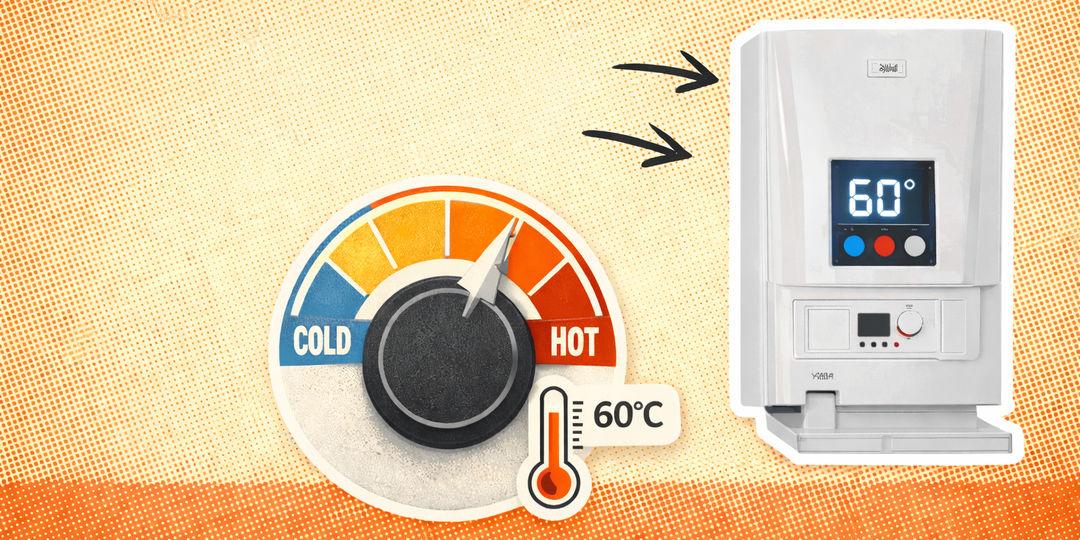

If your shower goes from arctic blast to volcano in 0.2 seconds, your boiler’s hot water temperature is probably set a bit… enthusiastic.
- [1] What “boiler temperature” actually means (people mix this up)
- [2] Quick answer: best hot water temperature in the UK
- [3] Recommended Temperature Settings
- [4] Don’t miss this: your heating temperature (radiators) matters too
- [5] Winter vs summer boiler settings
- [6] How to change your boiler temperature (step-by-step)
- [7] Common problems & troubleshooting
In this guide, we’ll cover the best hot water temperature settings for UK boilers (combi, system and regular), how to change them, and what to do if you’re still not getting decent hot water.
🔑 Key takeaways:
Combi boiler hot water (taps/showers) - start around 50°C, then adjust for comfort.
Hot water cylinder homes (system/regular) - store hot water at 60°C minimum (hygiene/Legionella control).
Central heating (radiators) - boiler flow temperature is a different setting to hot water.
Efficiency tip - lower heating flow temps can improve condensing efficiency (if your home still heats up properly).
Safety - water over ~50°C can scald quickly - be extra cautious with kids/older adults.
[1] What “boiler temperature” actually means (people mix this up)
Most people say “boiler temperature” when they actually mean three different things - so let’s untangle it.
Boiler temperature (flow temperature) - how hot the water is going round your radiators or underfloor heating.
Hot water temperature (DHW) - how hot the water comes out of your taps and shower (combi boilers), or how hot your cylinder stores it (system/regular boilers).
Thermostat temperature - the room temperature you want your home to reach (usually around 19–21°C).
Think of it like this: the thermostat decides how warm your home feels - the boiler flow temperature decides how hard your boiler has to work to get there. Different jobs, different settings.
[2] Quick answer: best hot water temperature in the UK
If you’ve got a combi boiler (no hot water cylinder):
Set your hot water (tap icon / DHW) to around 50°C as a sensible starting point.
It’s usually hot enough for showers without turning your bathroom into a health and safety incident.
Then tweak it based on real life:
Shower feels a bit meh? Nudge it up to 52–55°C
Water’s coming out like dragon breath (scald risk)? Drop it to 45–50°C
Live in a hard water area and temps keep bouncing around? Don’t crank it - keep it sensible and jump to the troubleshooting section (it’s often limescale/flow related, not “needs more heat”).
Pro tip: Make changes in small steps (2–3°C) and test for a day - your hands will tell you faster than your boiler manual will.
If you have a system/regular boiler with a hot water cylinder:
Set the cylinder to 60°C minimum.
This helps prevent bacteria growth in stored hot water.
If taps are too hot:
Don’t just crank the cylinder down. Usually the better fix is a thermostatic mixing valve (TMV) to blend hot + cold to a safe delivery temperature at taps.
[3] Recommended Temperature Settings
Home setup | Hot water setting | Why |
Combi boiler (taps heated on demand) | ~50°C (tweak 45–55°C) | Comfort + lower scald risk |
System/regular with cylinder | 60°C minimum | Hygiene/Legionella control for stored hot water |
Safety note: if you have vulnerable occupants, consider TMVs and safer outlet temps.
[4] Don’t miss this: your heating temperature (radiators) matters too
Hot water gets all the attention… but if you’re trying to cut bills (or stop the house feeling like a fridge), your central heating flow temperature is often the bigger deal.
What should my boiler be set at for central heating?
Ignore the room thermostat for a second - the setting you’re looking for is the radiator / heating icon on the boiler.
That’s your flow temperature (i.e. how hot the water is going round your radiators).
Typical ballpark for UK condensing boilers:
Colder weather: many homes sit around 60–70°C flow
(If your radiators are a bit small for the space, you might need it higher to keep up.)
Milder weather: you can often drop the flow temperature and still stay cosy
(and if it still heats the house properly, it’s usually more efficient).
The golden rule (don’t skip this):
Lower flow temps are only “more efficient” if your home still reaches temperature in a normal amount of time.
If turning it down means the boiler runs all day trying (and failing) to catch up, you’re not winning - you’re just cold.
Learn how you can save money by trading in your old boiler for a new, efficient model in our YouTube video below:
Why lower flow temps can help:
Condensing boilers are at their best when they can squeeze extra heat out of the flue gases. That happens more when the system water coming back to the boiler (the return temp) is cooler.
Lowering your flow temperature can lower the return temperature too - especially if:
your system is balanced properly
your radiators are doing their job
your controls (thermostat/TRVs) aren’t fighting the boiler
Bottom line: get it as low as you can while still staying warm. That’s the sweet spot.
[5] Winter vs summer boiler settings
Winter:
When it’s properly cold out, your boiler usually needs a bit more oomph.
Heating (radiators): you may need a higher flow temperature so the radiators can keep up and the house warms up in a normal time.
Hot water (combi): you usually don’t need to change much - around 50°C is still fine.
The exception is if your mains water is icy and showers feel a bit lukewarm - then a small bump (a couple of degrees) can help.
Summer:
In warmer months, you can often back things off.
Heating (radiators): many people can drop the flow temperature or just switch heating off entirely (while keeping hot water on).
Cylinder homes (system/regular): don’t get tempted to crank stored hot water right down for “efficiency”. Keep cylinder settings hygienic and safe (and use a TMV if you want cooler water at the taps).
Seasonal tweaks should make you comfy - not turn hot water into a science experiment.
[6] How to change your boiler temperature (step-by-step)
A) Combi boiler hot water (DHW / tap temperature)
This is the setting that controls how hot the water comes out of your taps and shower.
On the boiler display, find the tap icon (sometimes labelled Hot Water or DHW).
Set it to 50°C to start.
Turn on your hottest tap and let it run for 30–60 seconds (so you’re testing the real temperature, not leftover warm water in the pipes).
If you need to tweak it, do it in small jumps - 2–3°C at a time - until it feels right.
Tip: Don’t whack it up to “max” and hope for the best. That’s how you end up with a shower that screams.
B) Central heating (radiator flow temperature)
This one affects how hot the water is going round your radiators - not how hot your shower is.
Find the radiator icon (sometimes called Heating or CH).
If your home heats up quickly and stays warm, try dropping the flow temperature a little.
Give it 2–3 days to judge properly (one warm afternoon doesn’t count).
If rooms start taking ages to heat up - or never quite get there - nudge it back up.
Rule of thumb: Lower is great if you’re still comfortable. If you’re freezing, it’s not “efficient”, it’s just miserable.
C) Cylinder homes (system/regular boilers)
If you’ve got a hot water tank/cylinder, the temperature is usually set on the cylinder thermostat, not just the boiler.
Find the cylinder thermostat (usually a small dial strapped to the side of the hot water cylinder).
Set it to 60°C minimum (stored hot water needs to stay hygienic).
Check your programmer/timer so the cylinder heats at sensible times - many homes do well with morning + evening heat-ups rather than keeping it on all day.
If your taps are too hot: consider a thermostatic mixing valve (TMV) to deliver safer water at the tap while keeping the cylinder stored safely.
[7] Common problems & troubleshooting
“My hot water is too hot”
If your taps are basically breathing fire:
Combi boiler: turn the tap/DHW setting down toward 50°C (then test again).
Cylinder homes: keep the cylinder stored safely, and use (or adjust) a thermostatic mixing valve (TMV) so the water delivered at the tap is cooler.
If it suddenly changed overnight: that’s a red flag for a faulty thermostat/sensor (or mixing valve issue). Time to call a pro.
“My hot water goes cold quickly”
This usually depends on what type of system you’ve got:
Cylinder home: it’s often not “the boiler” - it’s the setup.
Common culprits include:
hot water schedule too short
cylinder stat set too low
immersion heater not working as expected
cylinder coil/controls issue
Combi boiler: if it starts hot then fades, look at:
flow rate too high (combis can struggle if you open the tap fully)
limescale/plate heat exchanger scaling (hard water areas, very common)
boiler modulation issues (the boiler not maintaining output properly)
“My shower temperature keeps changing”
The classic hot–cold–hot dance. Usually one of these:
Someone opens another tap (kitchen tap, toilet refill, washing machine) → your shower notices instantly.
Low mains pressure/flow or a failing thermostatic shower valve.
Hot water (DHW) set too high can make swings feel worse - because tiny changes in flow get magnified into big temperature jumps.
Quick test: try the shower when no other water is running. If it behaves then, the boiler’s not the main villain - your water demand/flow is.